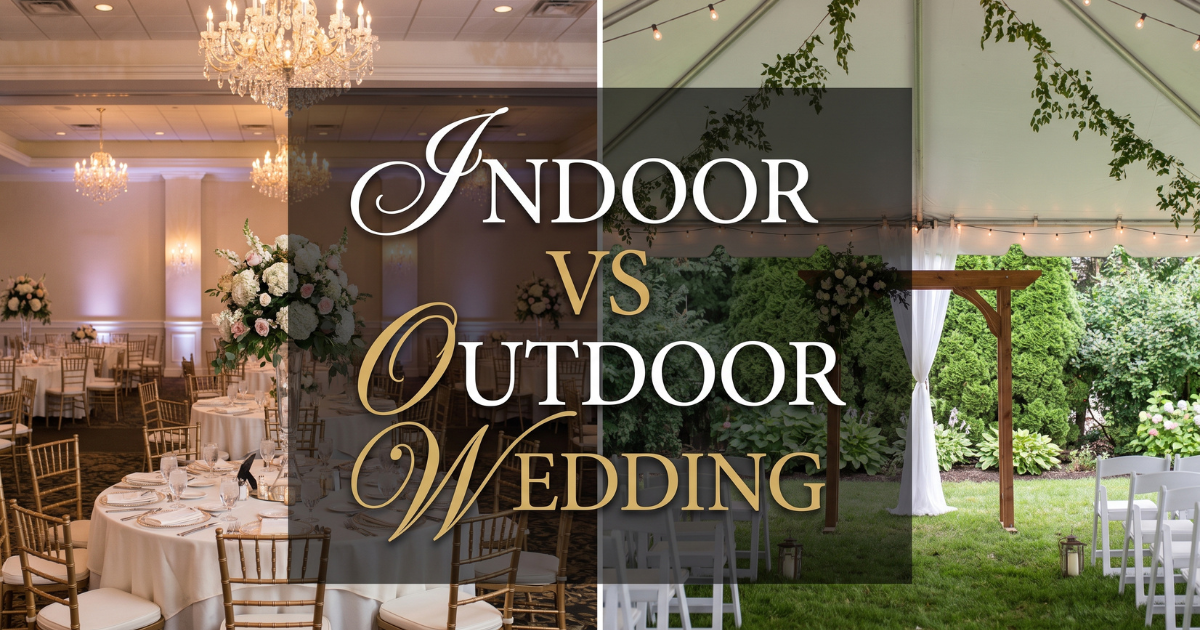
The indoor vs outdoor wedding decision is one of the first conversations most newly engaged couples have — and one of the most consequential ones.
It determines the venue type you search for. The season you consider. The budget you need. The photographer you choose. The florist you brief. The dress silhouette that works. The logistics of your entire day. Getting this decision right — based on genuine self-knowledge and honest practical assessment rather than which version photographs better on Pinterest — sets the foundation for every other planning decision that follows.

The good news is that this is not a question of which setting is better. It is a question of which setting is better for you — your personalities, your priorities, your guest list and the kind of day you actually want to have rather than the kind you think you are supposed to want.
This guide gives you a clear framework for making that decision — the honest advantages and disadvantages of each setting, the questions that reveal which is right for your specific situation and the factors most couples do not consider until it is too late to change.
The Case for an Outdoor Wedding
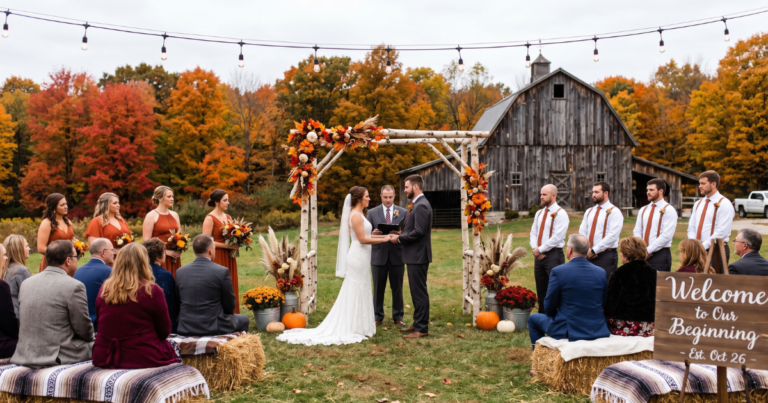
There is a reason outdoor weddings produce the most consistently beautiful photographs of any wedding setting. Natural light — golden hour specifically — does things to a wedding photograph that no indoor lighting system can replicate. The warmth, the depth, the way it catches fabric and flowers and faces with a quality that looks effortless and costs nothing. For couples who care deeply about their photographs, an outdoor setting gives their photographer a natural advantage that is genuinely difficult to achieve indoors.
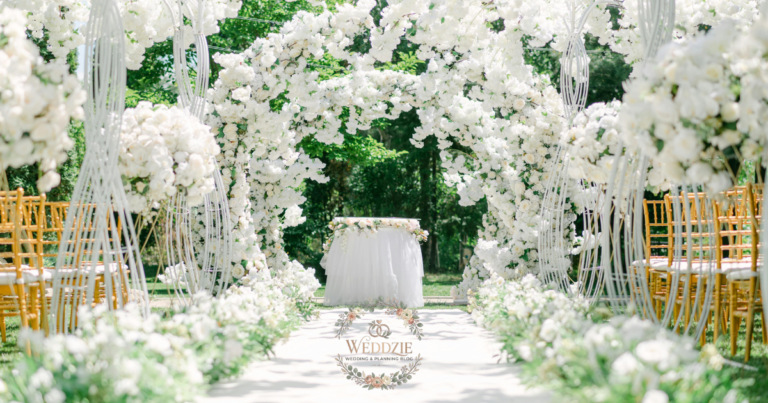
Beyond photography, outdoor weddings offer a specific kind of atmosphere that indoor venues simply cannot create. The feeling of a ceremony under open sky — surrounded by trees, or with a mountain view, or with the sea behind the arch — is irreducibly different from a ceremony in any room, no matter how beautiful that room is. There is a scale and a naturalness to it that connects the ceremony to something larger than the couple and the guests. Many couples describe their outdoor ceremony as the most genuinely moving version of a wedding they could have imagined — precisely because it felt so completely uncontained.
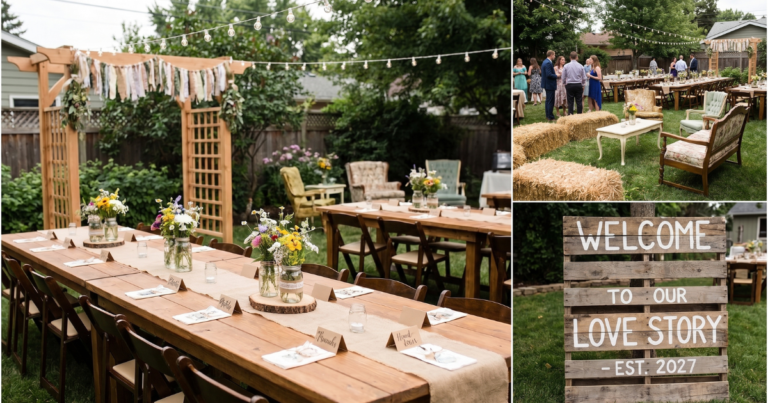
Outdoor settings also tend to offer more creative freedom than indoor venues. No catering exclusivity in most cases. No noise curfew at 10pm. No restrictions on what you can attach to what wall. A blank canvas in the most literal sense — a garden, a meadow, a vineyard — that you design from scratch rather than working within someone else’s aesthetic decisions.
The cost of an outdoor ceremony space is frequently lower than an indoor venue for the space itself — particularly for backyard weddings, park permits and private property events. The money saved on venue hire can be redirected to the elements that most directly affect guest experience.
The Honest Challenges of an Outdoor Wedding
Every advantage of an outdoor wedding comes with a counterpart that requires genuine planning rather than assumption.
Weather is not negotiable. An outdoor wedding without a genuine, confirmed, paid-for weather backup plan is a gamble with the most important day of your life. Not a slight risk. A real one. The weather backup needs to be as beautiful as the original plan — a backup that consists of squeezing guests under a leaking gazebo while the couple shelters in a parked car is not a backup plan. A full-scale tent large enough for every guest, set up before the wedding day, is a backup plan. Budget for it before you commit to an outdoor setting.
Logistics multiply significantly. An outdoor wedding requires you to bring everything that an indoor venue provides: power through a generator or power connection, restroom facilities through portable trailer hire if the natural facilities are insufficient, shade and heating depending on the season, a kitchen setup for catering and lighting for the reception once the sun goes down. None of these are impossible to manage. All of them add cost and coordination that indoor venues absorb invisibly.
Seasonal and climate considerations are non-negotiable. An outdoor June wedding in coastal Maine is a different proposition from an outdoor June wedding in Phoenix. An October wedding in the English countryside is different from October in Southern California. Know your specific location and your specific date before you commit. Research the average temperature, the historical rainfall data and the typical wind conditions for your exact wedding date. Then design your outdoor wedding around that reality rather than the version in your imagination.
Accessibility affects your guest list. Outdoor venues — particularly those with uneven terrain, gravel paths, wide grass areas or no covered walkways — create genuine accessibility challenges for elderly guests, guests with mobility limitations and guests attending with young children in pushchairs. Consider your specific guest list honestly before committing to a setting that may make attendance difficult for people who matter.
The Case for an Indoor Wedding
An indoor wedding offers something that outdoor settings cannot guarantee: certainty. The temperature will be controlled. The lighting will be managed. The event will not be rescheduled, relocated or compromised by conditions outside anyone’s control. For couples who experience significant anxiety around unpredictability, the controlled environment of an indoor venue is not a compromise — it is genuinely the right choice.
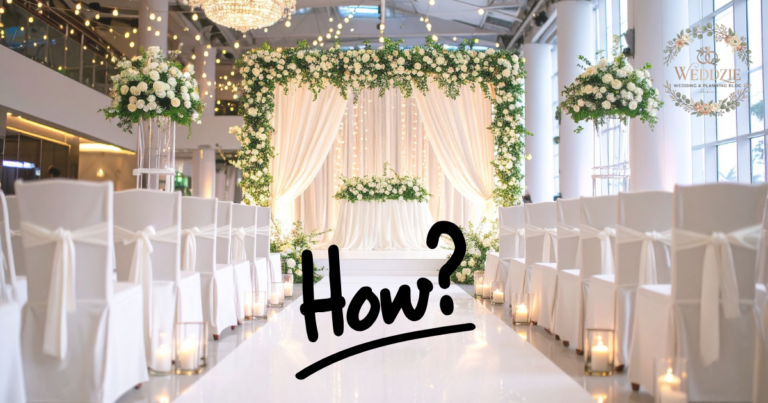
Indoor venues also provide an aesthetic completeness that outdoor settings require significant effort and expense to create. The room — its architecture, its lighting, its existing features — provides the atmosphere. The couple and their vendors layer their choices on top of an already finished foundation rather than building from a completely blank canvas. This can be enormously liberating for couples who feel creatively uncertain or who want the visual result to be guaranteed rather than dependent on their own design decisions.
The photograph quality of a well-lit indoor venue — whether that is a hotel ballroom with warm candlelight, a gallery with north-facing natural light or a restaurant with designer pendant lighting — is genuinely beautiful and produces wedding photographs that are consistently gorgeous across the entire day. Not golden hour gorgeous. Consistently gorgeous. An indoor wedding never has a bad light period — the lighting is designed to be flattering throughout.
Indoor venues also make catering significantly more manageable. Kitchen access is built in. Catering equipment has power. Food stays at the right temperature without the equipment logistics that outdoor catering requires. Service is faster, smoother and less dependent on weather-related variables.
For winter and late autumn weddings in most parts of the northern hemisphere, indoor is not just a preference — it is the practical reality. A truly warm, beautifully decorated indoor venue in January or February creates an atmosphere of cosiness, intimacy and warmth that is completely unique to the indoor winter wedding aesthetic and genuinely unavailable outdoors.
The Honest Challenges of an Indoor Wedding
An indoor wedding’s greatest strength — its controllability — is also its primary aesthetic limitation.
Natural light is not replicable indoors. A photographer working in a venue with inadequate natural light and poor artificial lighting produces photographs that no amount of skill can fully compensate for. Before booking any indoor venue, assess the natural light during a visit at the same time of day as your ceremony. Ask your photographer whether they have shot there before and what the light conditions are like. This single assessment prevents the most common indoor wedding photography disappointment.
Indoor venues impose their own aesthetic constraints. The carpet, the wall color, the existing architectural features are the backdrop for every photograph taken in the space. A venue with a dated interior or a color palette that clashes with your wedding aesthetic cannot be completely transformed by florals and candles. It can be improved significantly — but not completely overridden. Visit the venue and look at it critically, not optimistically.
Noise restrictions are more common indoors than outdoors, and venue rules about décor, vendor choices and end times are typically more prescriptive at indoor venues than at private outdoor spaces. Read every clause of an indoor venue contract before signing — the restrictions you discover after booking are consistently more limiting than the impression given during the sales tour.
The Six Questions That Reveal Which Setting Is Right for You
Rather than deciding based on aesthetics alone, answer these six questions honestly before making a final choice.
1. How do you genuinely feel about weather uncertainty? Not how you think you should feel — how you actually feel. If the thought of a rainy ceremony produces genuine anxiety rather than philosophical acceptance, an outdoor wedding will occupy significant mental space in the months before the event. An indoor wedding with beautiful candlelight and a warm atmosphere removes that variable entirely and gives you the mental space back.
2. What is your guest list’s physical reality? Are there elderly grandparents, guests with mobility limitations, guests with young children? An outdoor wedding with gravel paths, uneven ground and no covered transit routes creates real challenges for these guests that an indoor venue does not. If these guests matter to your day — and they do — their comfort should be a genuine factor in the decision.
3. What time of year and what part of the world? Summer outdoor weddings in mild climates are the most forgiving version of outdoor weddings. Winter outdoor weddings in cold, wet climates are the most challenging. Be honest about what your specific date in your specific location actually means for outdoor conditions. Not the best-case scenario. The realistic one.
4. What is your budget for logistics? An outdoor wedding that requires a generator, tent hire, portable restroom trailers, catering equipment, outdoor heating and lighting can cost $3,000 to $8,000 more than the same wedding in an indoor venue where all of these things are included. Know the full logistics cost before comparing outdoor to indoor on price.
5. How important is photography quality to you — and in what way? If golden hour natural light photographs are a primary priority, outdoor settings produce that more reliably. If consistent quality across the entire day — including dark reception rooms, dim speeches and low-light dancing — is the priority, a well-lit indoor venue with a good artificial lighting plan may serve you better. Discuss this specifically with your photographer before deciding.
6. Do you want to design your setting or inhabit one? Outdoor settings offer maximum creative control but require you to make many more design decisions. Indoor venues provide a complete aesthetic foundation but require working within existing design constraints. Neither approach is better — they suit different couples with different levels of creative confidence and available planning time.
The Hybrid Approach
Many of the most beautiful weddings in 2026 are neither fully indoor nor fully outdoor — they are deliberate combinations of both.
A ceremony in a garden or courtyard followed by a reception in an adjacent indoor ballroom or barn. A cocktail hour on a terrace at golden hour followed by dinner inside as the temperature drops. An entirely outdoor reception under a beautifully styled tent that functions as a room while remaining connected to the natural setting around it.
The hybrid approach captures the photographic advantages of outdoor natural light for the ceremony and portraits while providing the comfort, reliability and catering convenience of an indoor reception. For couples who feel pulled equally toward both settings, the hybrid is not a compromise — it is frequently the most considered and most beautiful option of all three.
When evaluating venues, specifically ask: is there a combination of indoor and outdoor spaces available? Can the ceremony and reception be in different settings on the same property? What is the transition between them — is it covered, how far is it and how long does it take? A venue with a well-designed indoor-outdoor flow gives you the best elements of both settings without any of the either-or anxiety.
Making the Final Decision
If you have answered the six questions honestly and still feel genuinely uncertain, try this approach.
Picture your ceremony. Not the decorations — the moment. Two people, an officiant, everyone you love. Now imagine it outdoors under a garden arch at 4pm with summer light filtering through trees. Then imagine it in a candlelit room with stone walls and high ceilings. Which version produces a stronger emotional response? Not a prettier image. A stronger feeling.
The setting that produces the stronger feeling is the right one. Everything else — the logistics, the lighting, the catering — is solvable. The feeling of the day is not.
The Weddzie Wedding Planner Bundle includes a complete venue research tracker, a venue comparison matrix, a questions checklist for every venue tour and a full wedding day timeline that works for both indoor and outdoor settings.
[→ Get the Weddzie Wedding Planner Bundle for $17 — Instant Download]
Frequently Asked Questions
Is an indoor or outdoor wedding cheaper? It depends entirely on the specific venues being compared and the logistics required. An outdoor wedding at a purpose-built outdoor venue with all logistics included can cost the same as or more than an indoor venue. A backyard outdoor wedding with DIY logistics can cost significantly less. The key variable for outdoor weddings is the cost of logistics — tent hire, generator, portable restrooms, outdoor heating and lighting — which can add $3,000 to $8,000 to the total that indoor venues absorb as standard inclusions.
What time of year is best for an outdoor wedding? Late May through early June and September through early October are the most reliably weather-stable months for outdoor weddings in most of the continental United States. These months offer mild temperatures, lower rainfall probability and the best natural light conditions for photography. Peak summer months — July and August — can produce excessive heat in many locations. November through March is genuinely challenging outdoors in most northern locations.
Do outdoor weddings need a backup plan? Yes — without exception. A genuine backup plan means a pre-installed tent large enough for your full guest count or an adjacent indoor space that can host the entire event at short notice. A vague plan to “see how the weather goes” is not a backup plan. Include your weather contingency in the venue contract and confirm who makes the weather call, when they make it and what additional costs — if any — are associated with moving to the backup option.
What is the biggest mistake couples make when choosing between indoor and outdoor? Choosing based on aesthetics alone without assessing the practical reality of their specific date, location and guest list. An outdoor setting that looks breathtaking on Pinterest in May looks genuinely challenging in November. The practical assessment — weather probability, guest accessibility, logistics costs — should inform the decision as much as the visual preference.
Can you have a winter outdoor wedding? Yes — with significant additional planning and budget. A winter outdoor wedding requires covered heating, appropriate lighting, weatherproof flooring, close proximity to indoor facilities and a guest list that is physically able to be comfortable in cold conditions. In genuinely mild winter climates — Southern California, Arizona, parts of Florida and Texas — an outdoor December or January wedding is entirely practical. In cold, wet northern climates it is a significantly larger logistical undertaking.
How do photographers prefer indoor vs outdoor weddings? Most wedding photographers prefer outdoor settings for natural light quality — particularly golden hour — but the best photographers produce consistently excellent work in both settings. The more relevant question is whether your specific photographer has experience with your specific venue setting and lighting conditions. Ask to see full galleries from weddings at similar venues before booking. A photographer who has successfully shot in the conditions your venue presents is more valuable than one with a beautiful outdoor portfolio who has never worked in a dim ballroom.