Here is the truth that most bridal boutiques will not tell you upfront:
The average wedding dress takes 4–6 months to arrive after ordering. Alterations take another 2–3 months. That means from the moment you order to the moment your dress is truly ready, you are looking at 6–9 months.
If your wedding is in 12 months and you have not started shopping — you need to move. Now.
If your wedding is in 8 months and you have not ordered yet — you are already in rush territory.
If your wedding is in 6 months or less — this guide has a section specifically for you.
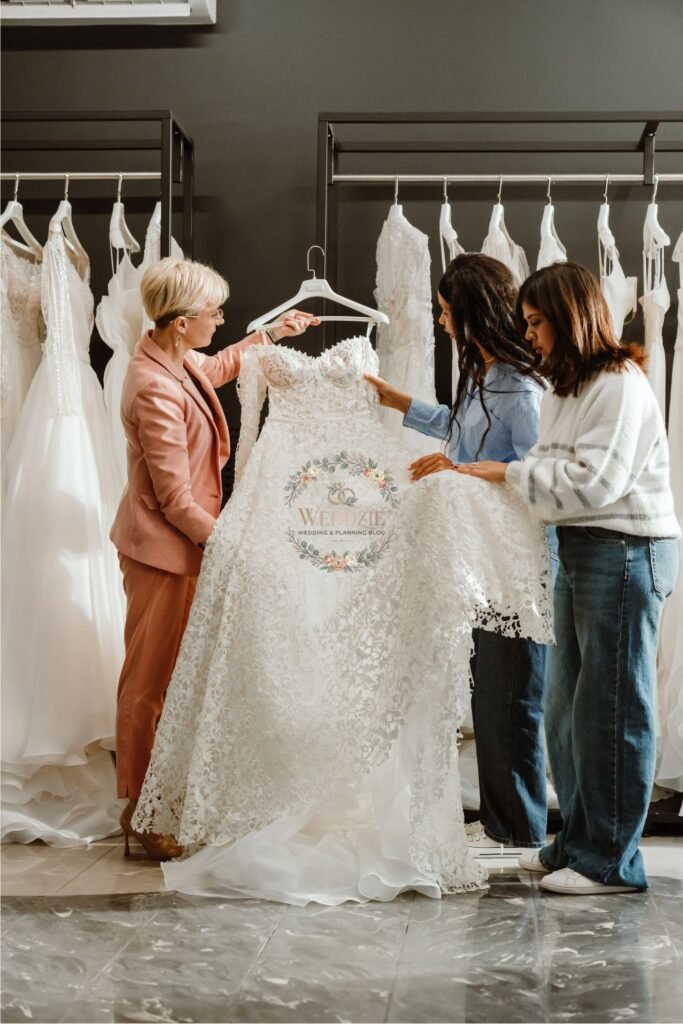
Knowing when to start shopping for your wedding dress is not just about having enough time. It is about having the right time — enough runway to shop without pressure, fall in love without rushing and arrive at your final fitting calm, confident and completely happy with what you see in the mirror.
This is the real wedding dress timeline every bride needs before she books her first appointment.
The Number Most Brides Get Wrong
Ask a bride how long wedding dress shopping takes and she will probably say a few weeks of appointments and then a few months to wait for delivery.
The reality is significantly different.
The complete wedding dress journey — from first research to final pickup — takes 9–14 months for a custom or designer gown ordered from a bridal boutique.
Here is how that breaks down:
| Phase | Duration |
| Style research | 1–2 months |
| Shopping appointments | 1–2 months |
| Dress production and delivery | 4–6 months |
| First fitting | 1 appointment, 4–6 months before wedding |
| Second and third fittings | 2 appointments, 2–3 months before wedding |
| Final fitting and pickup | 4–6 weeks before wedding |
| Total timeline | 9–14 months |
This is why the standard advice from every experienced wedding planner — and every bridal boutique coordinator who wants to be honest with you — is to start shopping 12 months before your wedding date.
Not because you need 12 months to find a dress. Because you need 12 months to find the right dress, order it, have it produced, receive it, alter it and pick it up without ever once feeling rushed.
The Complete Wedding Dress Timeline
Step 1: Start Researching Your Style (12+ Months Out)
The biggest mistake brides make at their first boutique appointment is arriving without any sense of what they want. They try on everything, feel overwhelmed by the options and leave more confused than when they arrived.
Research before you shop changes everything.
What to do 12+ months out:
Start a dedicated wedding dress inspiration folder — on Pinterest, in your phone’s saved photos or in a physical file. Save images not just of full dresses but of specific elements: necklines you love, sleeve styles that appeal to you, silhouettes that match your body and your venue.
After 2–3 weeks of saving, look at what you have collected and identify the patterns. Do most of your saved images have a similar silhouette? A particular neckline? A specific fabric? These patterns tell you what you actually want — not what you think you should want.
The silhouette question: Before your first appointment, know which silhouette categories appeal to you:
- A-line — fitted through the bodice, flares from the waist. Flatters almost every body type. The most universally popular silhouette.
- Ball gown — full, dramatic skirt from the waist. The classic princess silhouette. Requires a large venue to look proportional.
- Mermaid / Fit and flare — fitted through the body to the knee, flares at the hem. The most fitted and body-conscious silhouette.
- Sheath / Column — straight, minimal flare, falls close to the body. The most modern and minimalist silhouette.
- Tea length — falls between the knee and ankle. Relaxed, vintage-inspired, perfect for outdoor and garden weddings.
- Separates — bridal top and skirt purchased independently. Maximum customization, increasingly popular.
Your venue guides your dress: A dramatic ball gown in a small restaurant venue is impractical and visually overwhelming. A minimal sheath dress in a grand cathedral will look underwhelming. Your venue style — intimate or grand, indoor or outdoor, formal or relaxed — should significantly inform your dress silhouette and length before you walk into your first appointment.
Step 2: Book Your First Appointments (10–12 Months Out)
Most brides do not realize that bridal boutique appointments are not walk-ins. The best boutiques require appointments made weeks or even months in advance — particularly on weekends.
10–12 months before your wedding is the ideal time to book your first round of appointments.
How many boutiques to visit: Plan to visit 3–5 boutiques. Fewer than 3 does not give you enough comparison. More than 5 creates decision fatigue and makes it harder to commit. Choose boutiques that carry designers and styles aligned with your research — do not book appointments at boutiques whose aesthetic clearly does not match yours.
Who to bring: Bring a maximum of 2 people to your first appointment — ideally your partner or your maid of honor. More than 2 people creates conflicting opinions that override your own instincts. The people who love you most sometimes make dress shopping harder, not easier, because they have opinions about what they think you should wear.
What to bring: Wear seamless nude underwear. Bring any shapewear you plan to wear on the wedding day. Bring your wedding shoes or a pair of heels at the same height. If you have already chosen your veil or hair accessories, bring them — seeing the complete picture helps enormously.
What to tell the consultant: Tell the consultant your wedding date, your venue style, your silhouette preferences from your research, your budget and your body concerns — if any. A good consultant uses all of this information to pull dresses before you arrive, saving time and improving the quality of options you try.
Step 3: Shop and Fall in Love (9–11 Months Out)
This phase is where most brides spend the most time — and where the most emotional decisions happen.
The reality of trying on wedding dresses:
Dresses look completely different on a hanger than on a body. Styles you were certain you would love sometimes disappoint. Styles you never considered sometimes stop you in your tracks. Go into every appointment with an open mind and a willingness to try things outside your comfort zone.
The sample size reality: Bridal boutique samples are typically stocked in sizes 10–14. If you are significantly smaller or larger than the sample size, a consultant will clip the back to show fit. This is normal and universal — do not be disheartened by a dress that does not close in the sample. Focus entirely on the front-facing silhouette and the fabric.
How to evaluate a dress honestly: When you put on a dress that feels like a contender, stand in front of the mirror and ask yourself these questions:
- Does my face light up?
- Do I feel like myself — or like I’m wearing a costume?
- Does this fit my venue and my personality?
- Would I be comfortable in this for 10 hours?
- If a friend described this dress to me, would I be excited?
The dress should answer yes to all of these. Not most of them. All of them.
The “it” moment: Most brides describe finding their dress as a distinct moment — something shifts. Not necessarily tears (though that happens) but a quiet certainty. If you are still actively comparing and analyzing, you have not found it yet. When you find it, you know.
Do not buy on the first appointment: Unless you are absolutely certain — and your budget is clear and your venue is confirmed — do not purchase on the first appointment. Allow yourself at least one additional appointment, ideally at a different boutique, before making a final decision. Urgency is a sales tactic. The right dress will still be available in two weeks.
Step 4: Say Yes to the Dress and Order (9–10 Months Out)
When you have found the dress and you are ready to order, the clock genuinely starts.
What happens when you order:
The boutique takes your measurements and orders your dress in the closest standard size to your measurements — typically sizing up rather than down, because fabric can always be taken in but cannot be added. This is standard practice and does not reflect your actual size in any meaningful way.
The production timeline reality:
Most designer bridal gowns are not kept in stock. They are manufactured to order — which means the production process begins when you place your order. Production timelines vary by designer and style:
| Production timeline | Typical for |
| 4 months | Mid-range brands, simpler designs |
| 5–6 months | Most major bridal designers |
| 6–8 months | Luxury and couture designers |
| 8–12 months | Fully custom or bespoke gowns |
The deposit: Most boutiques require a 50% deposit at the time of ordering with the balance due at pickup. Get a written receipt for your deposit and keep a copy of your order form — confirming the exact dress name, style number, size ordered, color, any customizations and the expected delivery date.
Rush orders: If you are ordering with less than the standard production time available, ask your boutique about rush production. Most designers offer rush services for an additional fee — typically $100–$500 depending on the brand and the urgency. Rush does not guarantee perfect quality and should be a last resort, not a plan.
Step 5: The First Fitting (4–6 Months Out)
Your dress arrives at the boutique — typically 4–6 months before your wedding date — and your first fitting is scheduled.
What happens at the first fitting:
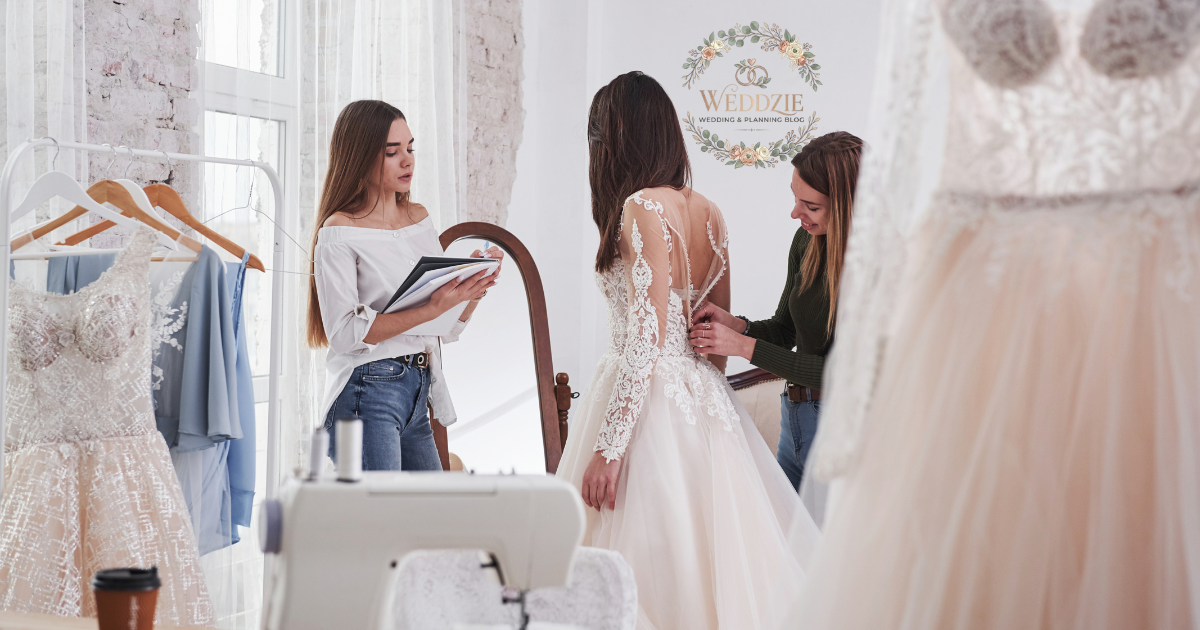
You try on your dress for the first time since ordering. The dress is in your ordered size — which almost never fits perfectly off the rack. This is completely normal. The purpose of this fitting is for your seamstress or alterations specialist to assess what needs to be done: taken in, let out, hemmed, bustled, straps adjusted.
Common alterations at the first fitting:
- Taking in the sides through the bodice
- Hemming to your exact shoe height
- Adjusting the neckline depth
- Adding or adjusting bra cups
- Modifying strap length
- Adding a bustle to the train for the reception
Should you use the boutique’s alterations service? Most boutiques offer in-house alterations. This is convenient but not always the best value — boutique alteration prices can be significantly higher than an independent seamstress. Ask for a quote before committing. If the price seems high, you have the right to take your dress to an external alterations specialist.
What to bring: Your wedding shoes — the exact pair, not approximations. Your undergarments. Any shapewear. If you have chosen your veil, bring it.
Step 6: Second and Third Fittings (2–3 Months Out)
After the first fitting, your seamstress makes the initial alterations and schedules follow-up fittings to check the work and make further adjustments.
Most brides need 2–3 fittings total. Complex dresses — heavily beaded, with long trains or intricate corset backs — may require more.
What to expect at each fitting: Each fitting progressively refines the fit. The second fitting typically checks that the major alterations are correct and makes smaller adjustments. The third fitting — often called the “final fitting” — should produce a dress that fits perfectly and requires no further work.
The weight question: Many brides plan to lose weight between ordering and their wedding. This creates a timing dilemma: order in your current size and potentially need significant taking-in, or order smaller and risk the dress not fitting at all if the weight loss does not happen as planned.
The honest advice: order in your current size. Seamstresses can take a dress in by 1–2 sizes relatively easily. They cannot add fabric where there is none. A dress that is too small cannot be fixed. A dress that is slightly too large can always be altered.
Keep your measurements stable: In the 2–3 months before your wedding, try to maintain your current measurements as consistently as possible. Significant weight changes — in either direction — between your last fitting and your wedding day create problems that cannot always be fixed in time.
Step 7: Final Fitting and Pickup (4–6 Weeks Out)
Your final fitting is the last time you put on your dress before your wedding day. It should feel perfect — no pins, no adjustments, no uncertainty.
What to do at your final fitting: Wear your dress for at least 30 minutes. Walk in it. Sit in it. Practice your first dance movement if you can. Raise your arms, turn around, hug someone. Any discomfort or restriction that appears in 30 minutes of real movement needs to be addressed before pickup.
Practice the bustle: If your dress has a train with a bustle for the reception, practice fastening it at this fitting and teach at least two people — your maid of honor and one backup — how to do it. The bustle is often done during the reception transition and needs to be fastened quickly, correctly and without the bride’s help.
Steaming: Ask your boutique whether the dress will be steamed before pickup. If not, arrange steaming independently — a wrinkled wedding dress on your wedding morning adds unnecessary stress to an already full day.
Storage before the wedding: Hang your dress in a breathable garment bag in a cool, dry location — not a closet packed with other clothes where it might be compressed or shifted. Keep it out of direct sunlight. Do not store it in a plastic bag — it needs to breathe.
What If You Are Already Behind?
If your wedding is approaching and you have not started shopping yet — here is the honest reality by timeline:
6–9 months before the wedding: You are in rush territory but not in crisis. Many designers offer rush production for an additional fee. Off-the-rack options — designer samples sold directly from boutiques — are available immediately and require only alterations. This is a completely viable path to a beautiful dress with no production wait. Some online bridal retailers (BHLDN, Azazie) ship in 2–4 weeks and offer rush production at reasonable prices.
3–6 months before the wedding: Off-the-rack is your primary option for a traditional boutique dress. Focus your search on boutiques with strong sample selection in or near your size. Alterations at this timeline are still very achievable — 3 months is enough time for full alterations if you book your seamstress immediately.
Under 3 months before the wedding: Off-the-rack and online retailers that ship within 2 weeks are your options. BHLDN, Azazie, Revelry and several other online retailers specialize in fast-turnaround bridal gowns at accessible prices. Many brides in this situation find beautiful dresses that require minimal alterations. Book your seamstress the moment you purchase.
The most important rule if you are behind: Do not panic. Thousands of brides every year find and wear beautiful wedding dresses on very short timelines. The difference is knowing your options and moving decisively. Spend no more than one week searching before you make a decision — paralysis at this stage is the only real risk.
How to Make the Most of Every Appointment
Arrive on time — or early. Boutique appointments are typically 60–90 minutes. Arriving late shortens your session and rushes every decision.
Put your phone down. Looking at dresses through a phone screen creates distance from the experience. Be present. Take a few photos of your favorites at the end of the appointment — not during every try-on.
Trust the consultant — to a point. A good bridal consultant knows her inventory better than you do. If she suggests something outside your comfort zone, try it. If she is pushing dresses clearly outside your stated budget, redirect firmly.
Keep a record of every dress you try. After every appointment, write down the style name, style number and boutique for every dress you liked. This information disappears from memory faster than you expect.
Do not crowdsource your decision. The more people you ask — friends, family, social media — the more conflicting opinions you collect. Your wedding dress should reflect you. The only opinions that matter are yours and your partner’s.
The Hidden Costs of Wedding Dress Shopping
The price tag on the dress is not what you will actually pay. Before you set your dress budget, understand the full cost picture:
| Cost item | Typical range |
| The dress | $1,200–$4,000 (mid-range designer) |
| Alterations | $300–$1,200 depending on complexity |
| Veil | $100–$600 |
| Undergarments and shapewear | $80–$200 |
| Shoes | $100–$400 |
| Dry cleaning and preservation | $200–$400 |
| Rush production (if needed) | $100–$500 |
| Realistic total | $2,080–$7,300 |
When setting your dress budget, budget for the full outfit — not just the gown. Alterations alone surprise more brides than almost any other wedding cost.
Stay Organized Through Every Step
Wedding dress shopping involves multiple appointments, measurements, payment schedules, alteration sessions and pickup logistics — all happening across the busiest planning period of your engagement.
The Weddzie Wedding Planner Bundle includes a complete dress shopping appointment tracker, measurements and alterations timeline, final decision details page and accessories checklist — so every dress-related task is organized in one place from first appointment to wedding morning.
[→ Get the Weddzie Wedding Planner Bundle for $17 — Instant Download]
65+ pages of planning tools, Google Sheets trackers, 10 Canva templates and everything you need to plan your wedding without missing a single detail.
Frequently Asked Questions
When should I start shopping for my wedding dress? Start shopping 10–12 months before your wedding date. This gives you 1–2 months to research and shop, 4–6 months for the dress to be produced and delivered, and 3–4 months for alterations and fittings. Starting earlier than 12 months is fine — starting later than 9 months puts you in rush territory for most designer gowns.
How long does it take to get a wedding dress after ordering? Most designer bridal gowns take 4–6 months from the order date to arrive at the boutique. Luxury and couture designers can take 6–8 months. Rush production is available from most designers for an additional fee and typically reduces the timeline to 8–12 weeks.
How many dress appointments should I go to before deciding? Visit 3–5 boutiques and try on dresses at each. Most brides find their dress within 2–3 appointments. If you are still undecided after 5 appointments, revisit your top 2 contenders rather than continuing to search — decision fatigue at this point makes choosing harder, not easier.
Can I buy a wedding dress without an appointment? Some boutiques accept walk-ins during off-peak hours. Most require appointments — particularly on weekends. Popular boutiques often book appointments 2–4 weeks in advance. Always call or book online before visiting.
How much should I budget for wedding dress alterations? Budget $300–$800 for standard alterations on a mid-complexity gown. Complex dresses with heavy beading, intricate construction or significant size adjustments can cost $800–$1,200 in alterations. Always request a quote before agreeing to alterations — you are not obligated to use the boutique’s alteration service.
What size should I order my wedding dress in? Order the size closest to your largest measurement — boutiques typically recommend sizing up so fabric can be taken in rather than out. Wedding dress sizes run small compared to standard clothing sizes; most brides order 2–4 sizes larger than their usual clothing size. Do not take this personally — it is a standard industry practice.
Can I lose weight between ordering and my wedding? Yes — but order in your current size, not your goal size. Seamstresses can take a dress in by 1–2 sizes relatively easily. If your goal size does not materialize, a dress that is too small cannot be fixed in time. A dress ordered in your current size can always be altered down. The risk is entirely asymmetric — always order to your current measurements.
What should I do if my dress arrives damaged or incorrect? Contact the boutique immediately and document everything with photographs before doing anything else. Most boutiques have a clear process for damaged or incorrect orders — the manufacturer is typically responsible for production errors. If the boutique is unresponsive, contact the designer directly. This is exactly why wedding insurance is worth purchasing.
Save this article and send it to anyone you know who just got engaged. The wedding dress timeline is the most commonly misunderstood part of wedding planning — and the most expensive mistake to fix.
📦 Get the Weddzie Wedding Planner Bundle — includes your dress shopping appointment tracker, measurements log, alteration timeline and every other planning tool you need. $17, instant download.