A $10,000 wedding budget is not a limitation. It is a decision.
Most couples who spend $30,000 on their wedding will tell you they do not know where half the money went. Couples who spend $10,000 intentionally — who choose every line item with a clear reason — often end up with a more personal, more beautiful and more memorable wedding than those who spent three times as much without a system.
The difference between a $10,000 wedding that looks cheap and one that looks stunning comes down to one thing: knowing exactly which decisions produce visible value and which ones drain your budget invisibly.
This guide tells you exactly where to spend, where to save and how to build a complete $10,000 wedding that your guests will talk about for the right reasons.
Start With the Real Number
Before you plan a single thing, you need to know what $10,000 actually buys.
$10,000 is your total budget. That means venue, catering, photographer, dress, florals, cake, invitations, hair and makeup, transport and everything else. Not $10,000 for the venue and then more money for everything else. Ten thousand dollars. Total. End.
Write that number down. Put it at the top of your budget tracker. Every single decision gets measured against it.
The couples who go over budget on a $10,000 wedding are not the ones who made one big expensive mistake. They are the ones who made fifteen small expensive mistakes while telling themselves each one was reasonable.
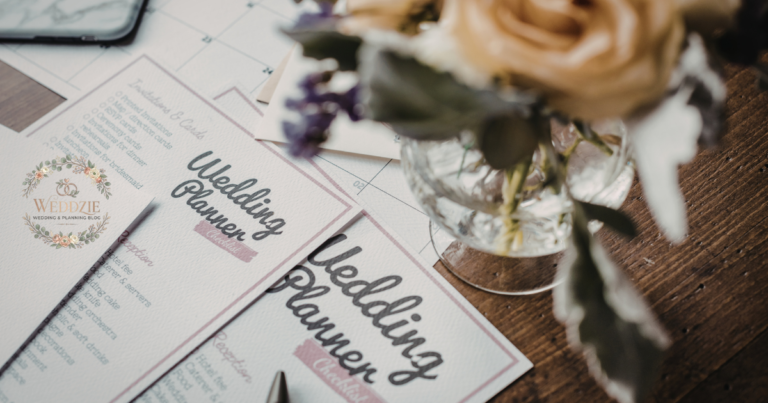
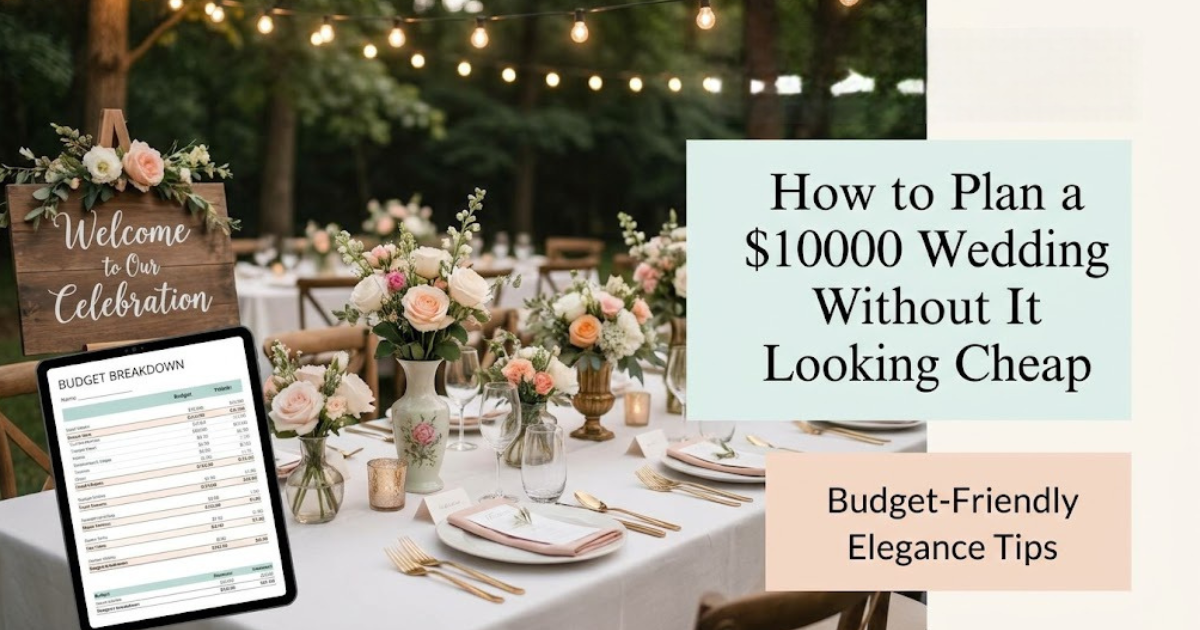
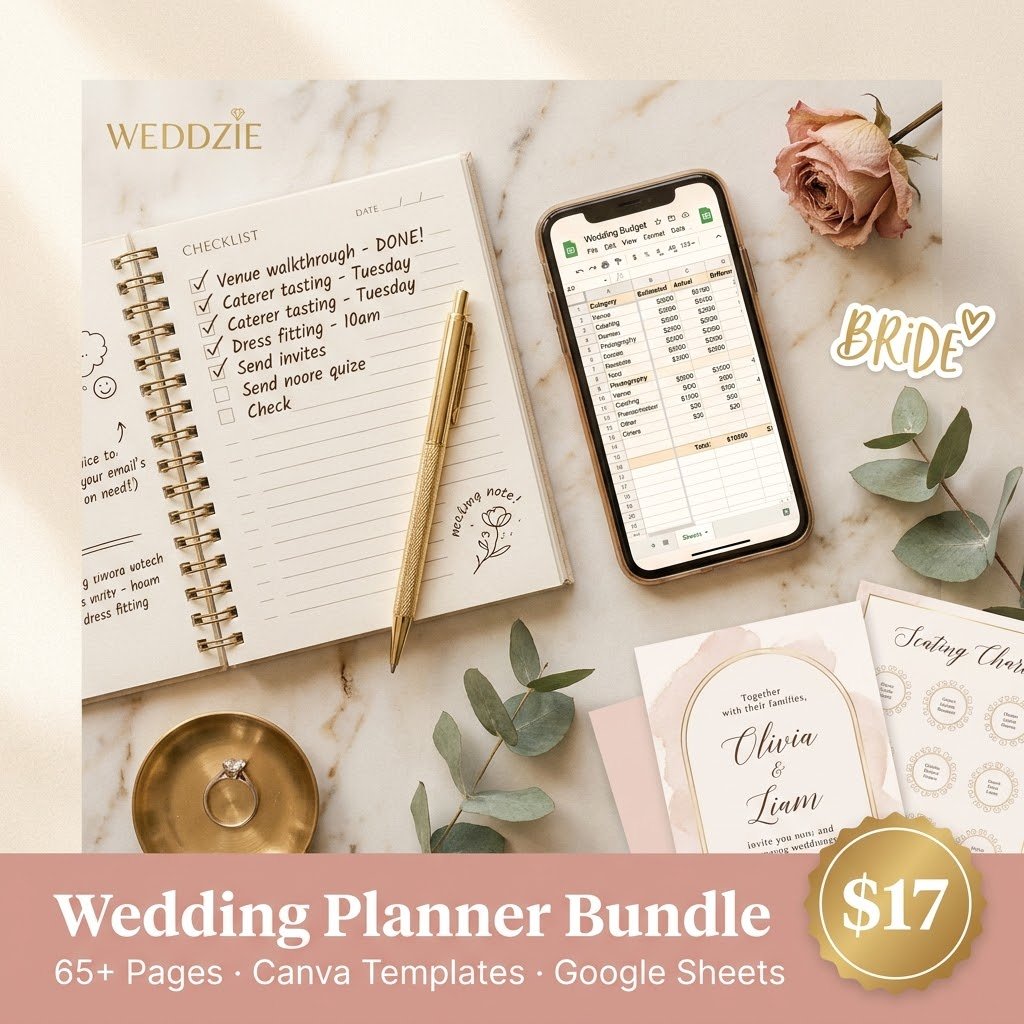
The Weddzie Wedding Budget Tracker — included in the Weddzie Wedding Planner Bundle — is built specifically for this kind of intentional budget management. Every category is pre-loaded, every dollar is tracked automatically and every overspend is visible before it happens.
[→ Get the Weddzie Wedding Planner Bundle for $17 — Instant Download]
The $10,000 Wedding Budget Breakdown
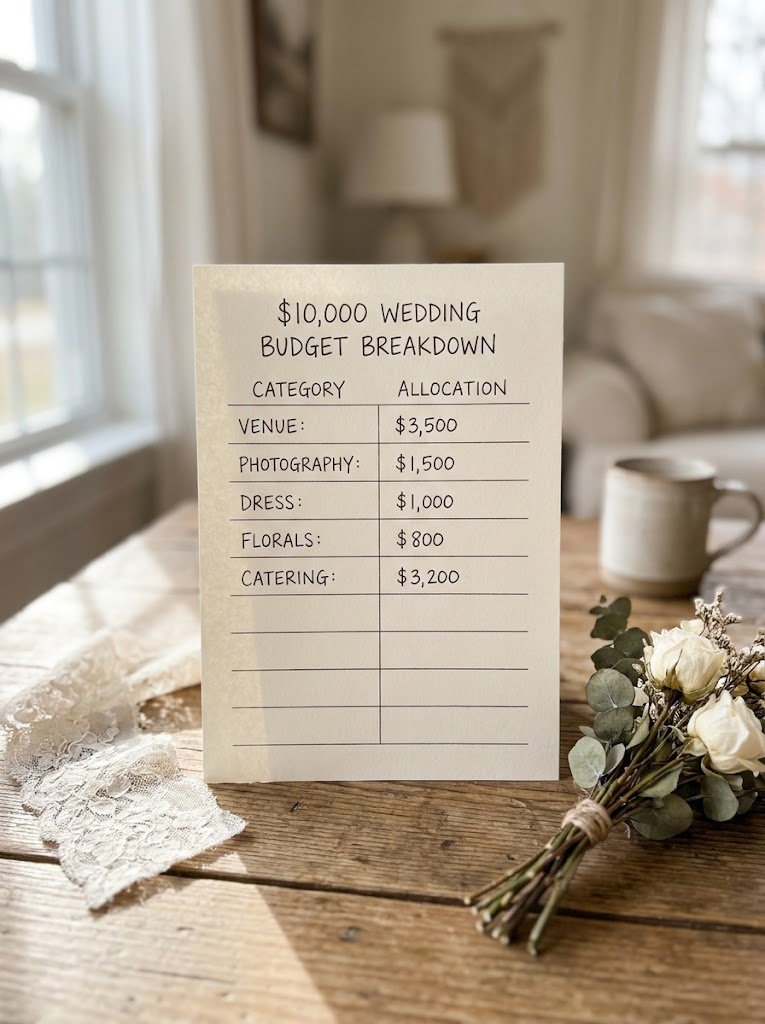
Here is a realistic allocation that produces a beautiful result:
Venue and catering: $4,000–$4,500 Photography: $1,200–$1,500 Dress and alterations: $800–$1,200 Florals and décor: $500–$800 Cake: $300–$500 Hair and makeup: $300–$500 Invitations and stationery: $150–$250 Officiant: $200–$350 Transport: $150–$250 Rings: already purchased or separate budget Miscellaneous and emergency fund: $300–$500
Total: $7,900–$10,350
This allocation works. It is not theoretical. It reflects what real couples spend when they plan with discipline and book the right things at the right price points.
The Four Decisions That Determine Everything
There are four decisions in a $10,000 wedding that will either make your budget work or break it before you have started. Get these right and the rest of the planning falls into place.
Decision 1: The day of the week
A Saturday wedding in peak season is the most expensive version of your wedding. The exact same venue, caterer and photographer costs significantly less on a Friday, Sunday or weekday. Most venues charge 30–50% less for non-Saturday events. Most photographers offer Friday and Sunday discounts of $200–$500. Your guests — the ones who genuinely love you — will show up on a Sunday. The ones who will not come on a Sunday were always borderline on the guest list.
Decision 2: The guest count
Your guest count is your single biggest budget lever. Every person you invite costs you $50–$100 in catering, a slice of cake, a seat, a favor and a place card. A wedding of 50 guests on $10,000 gives you $200 per head. A wedding of 100 guests on $10,000 gives you $100 per head. One of those weddings has abundant food and feels generous. The other feels thin. Do the math before you write a single name on the guest list.
Decision 3: The venue type
A traditional event venue with in-house catering will consume the majority of your $10,000 before you have booked a single other vendor. A restaurant private dining room, a community hall with outside catering, a backyard, a local park pavilion or a beautiful home are all options that give you a stunning result at a fraction of the cost. The venue does not need to be purpose-built for weddings. It needs to be beautiful, practical and affordable.
Decision 4: What you prioritize
Every wedding has one or two elements that matter most to the people getting married. For some couples it is the food — they want their guests to eat exceptionally well. For others it is the photographs — they want images that last a lifetime. For others it is the florals or the music or the dress. Identify your one or two priorities and protect them. Reduce everything else. A wedding where one element is truly excellent and the rest are carefully managed always outperforms one where ten elements are mediocre.
Where to Spend the Money
Photography: do not cut this
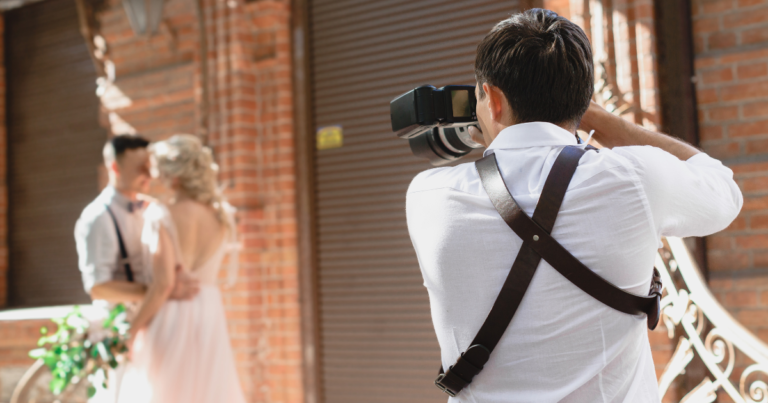
Your photographs are the only thing from your wedding that will still exist in thirty years. The venue will be renovated. The cake will be eaten. The flowers will wilt. The photographs remain. For a $10,000 wedding, budget $1,200–$1,500 for a photographer. This is achievable — there are genuinely talented emerging photographers at every price point. Look for photographers who are building their portfolio, recently established within the last two to three years, or based slightly outside your city. Ask for full galleries from two to three recent weddings before booking — not just the highlight images that appear on their website.
Catering: feed your guests well
Hungry guests are unhappy guests regardless of how beautiful everything else looks. Food and beverage is where most budget weddings lose their guests’ goodwill. A self-catered grazing table and a food truck costs less than a traditional caterer and often delivers a better experience. Family-style service costs less per head than plated individual meals. A cash bar or a limited drinks package costs less than an open bar while still feeling generous. Whatever you serve, make sure there is enough of it.
The dress: this is the one time to shop smart
The average bride spends $1,400 on a wedding dress before alterations. On a $10,000 budget, $800–$1,200 including alterations is your target. BHLDN by Anthropologie sells genuinely beautiful gowns from $200–$600 with the quality to justify every dollar. Azazie sells made-to-measure bridal gowns from $150–$400. Sample sales at bridal boutiques regularly discount $2,000–$4,000 designer gowns to $300–$700. The right dress at $400 looks more elegant than the wrong dress at $2,000.
Where to Save the Money

Florals: go seasonal, go greenery-forward
Flowers are the easiest place to overspend and the easiest place to save without any visible reduction in beauty. A greenery-forward arrangement — eucalyptus, ferns, olive branches as the base — uses seasonal flowers as accents rather than the primary element. This approach costs 40–60% less than a traditional bloom-heavy arrangement. Buying wholesale from Costco, Sam’s Club or a local wholesale market and arranging with a creative friend produces results that are photographically indistinguishable from a professional florist at two to three times the cost.
Cake: the Costco approach
Costco wedding cakes start at $20 for a sheet cake that serves 50 people. Order a small decorative cutting tier from a local baker for $150–$200, use it for the ceremonial cutting photographs, then serve the Costco sheet cake from the kitchen. Your guests eat excellent cake. You spend $200 instead of $800. Nobody in the history of weddings has ever asked their guest “did you notice the cake was from Costco.”
Invitations: digital first, printed minimally
Digital wedding invitations via Paperless Post or Zola are free to beautiful and eliminate printing, envelope, stamp and assembly costs entirely. If you want printed invitations — and many couples do — Canva Pro produces genuinely elegant designs that can be printed at home or at a local print shop for $0.15–$0.25 per sheet. The Weddzie Wedding Planner Bundle includes editable Canva invitation templates specifically designed for this purpose.
Décor: thrift, borrow and DIY strategically
Candles are the single highest-impact, lowest-cost décor element at any wedding. A table with fifty white pillar candles at different heights looks more romantic and more expensive than a table with a $300 floral centerpiece under fluorescent light. IKEA pillar candles, amber glass votives from any thrift store and simple greenery runners from a craft store or your own garden can transform any venue for under $200 total.
Entertainment: a great playlist beats a mediocre DJ
A genuinely excellent Spotify wedding playlist costs nothing and sounds better than a DJ who does not know your taste. If you want live energy, hire a DJ for the reception only — not the ceremony and cocktail hour — to reduce the booking by two to three hours. Many DJs will negotiate on a shorter booking. An alternative: hire a single musician — an acoustic guitarist or a saxophonist — for the ceremony only at $200–$400, which creates the feeling of live music for the most important twenty minutes of the day.
The Details That Make a Budget Wedding Look Elevated
There is a version of a $10,000 wedding that looks like it cost $10,000. And there is a version that looks like it cost twice that. The difference is almost never about how much was spent. It is about the quality of execution on a few specific details.
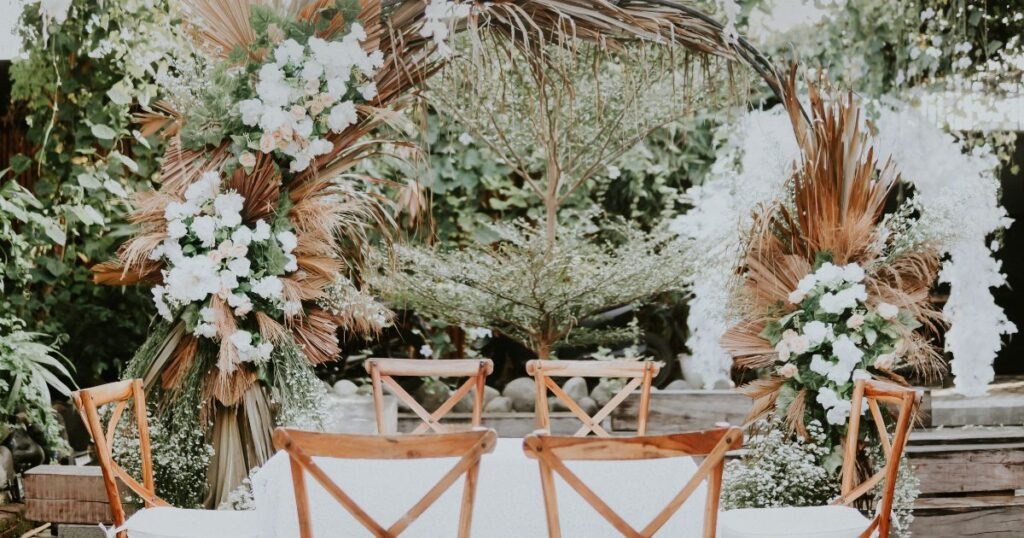
Consistent color palette. Choose three colors and use them everywhere — florals, candles, ribbon, stationery, bridesmaid dresses. Consistency reads as intention. Intention reads as elegance. A wedding with seven colors happening simultaneously looks busy regardless of how much each element cost individually.
One good tablecloth. A plain white linen tablecloth makes every table look more expensive. A cheap synthetic tablecloth makes every table look less expensive. The difference in cost between the two is $5 per table from any party rental company. Rent linens. It is always worth it.
Good lighting. String lights cost $30–$80 to purchase or $100–$200 to rent for the reception space. Under warm string lighting, a simple venue becomes romantic. Under fluorescent overhead lighting, a luxurious venue looks institutional. If your venue has overhead fluorescent lighting, ask specifically about dimming options or bring your own string lights and battery-powered uplights.
A clear, on-time schedule. Nothing makes a budget wedding feel disorganized faster than a reception that runs late, has long gaps between moments or requires guests to wait for food. A clean, well-executed timeline makes every other element look better than it is. Use the Weddzie Wedding Day Timeline Template to build yours before you brief any vendor.
The One Rule That Covers Everything
Spend intentionally on what your guests experience. Save ruthlessly on what they do not notice.
Your guests notice the food, the music, the atmosphere and whether the people getting married seem genuinely happy. They do not notice the calligraphy on the menus, the brand of champagne in the toast, the thread count of the napkins or whether the centerpieces were professionally arranged or assembled the night before by four bridesmaids at a kitchen table.
A $10,000 wedding planned with this principle looks exactly as beautiful as it should. Because the things that make a wedding beautiful — joy, warmth, genuine food, real photographs, the right people — are not proportional to the budget. They are proportional to the intention.
[→ Get the Weddzie Wedding Planner Bundle for $17 — Instant Download]
The bundle includes the complete budget tracker, vendor contact system, wedding day timeline and every other planning tool you need to execute a $10,000 wedding that looks like twice the price.
Frequently Asked Questions
Is $10,000 a realistic wedding budget in 2026? Yes — with the right decisions. A $10,000 budget requires a non-Saturday date or an off-peak season, a guest list under 60–75 people, a non-traditional venue and intentional spending in photography and catering above all else. Couples who plan with a clear budget system and make their four key decisions early consistently deliver beautiful weddings at this price point.
What should I prioritize on a $10,000 wedding budget? Photography and food. These are the two elements your guests experience directly and remember longest. Everything else — florals, cake, invitations, décor — can be scaled down without meaningfully affecting the quality of the day. A wedding with exceptional food and genuine photographs at $10,000 will be remembered as a great wedding. One with elaborate décor and forgettable food will not.
How many guests can I invite on a $10,000 budget? A comfortable maximum is 50–75 guests for a $10,000 budget that includes venue and catering. Below 50 guests the per-head budget becomes generous enough to accommodate a wider venue choice. Above 75 guests the catering cost alone begins to exceed what the total budget can support without severe cuts elsewhere.
Can I have a nice venue on a $10,000 wedding budget? Yes — if you look beyond purpose-built wedding venues. Restaurant private dining rooms, community halls, backyard and garden venues, local parks, museum spaces, winery tasting rooms and art galleries all offer beautiful settings at accessible prices. Many of these venues charge $500–$2,000 for a full-day booking versus $5,000–$12,000 for a traditional wedding venue.
How do I avoid a $10,000 wedding looking cheap? Focus on three things: consistent color palette, warm lighting and good food. These are the three elements that determine whether a budget wedding reads as elegant or underdone. Add clean white linen tablecloths, abundant candles and a well-timed schedule and the budget becomes invisible to your guests.
Should I use a wedding planner for a $10,000 budget? A full-service wedding planner typically charges $2,000–$5,000 — which represents 20–50% of your total budget. For a $10,000 wedding, a comprehensive digital planning system like the Weddzie bundle at $17 gives you the same organizational structure at a fraction of the cost. If you want human support, a day-of coordinator at $400–$800 is the highest-value single hire you can make